
Obsessive Compulsive Disorder (OCD) is a mental health condition that affects the individual’s thoughts, feelings, routines, and relationships in a significant way. Often mistaken for being too neat, perfectionist, or over-checking. But OCD is far more complicated than that. Intrusive, upsetting, repetitive thoughts. Repetitive behaviors or mental rituals that interfere with functioning or cause distress
With proper diagnosis and treatment, people with OCD can learn to manage and live with the disorder and improve their quality of life. Part of the process of getting professional support is knowing and understanding what to expect in the diagnostic journey, the treatment, and the place of medication.
What Is OCD?
OCD is an acronym for Obsessive Compulsive Disorder. In the Diagnostic and Statistical Manual of Mental Disorders, Fifth Edition, Text Revision (DSM-5-TR) OCD is listed under Obsessive-Compulsive and Related Disorders.
The condition is reflected through two types of behaviors:
- Obsessions: Recurrent and persistent thoughts, images, or impulses that are intrusive and cause anxiety or distress.
Examples of obsessions:
- Persistent concerns about contamination
- Safety issues
- Obtrusive thoughts about harming someone
- Compulsions: Behaviors that a person feels compelled to perform repeatedly in response to an obsession or according to rules that must be applied rigidly.
Examples of compulsions:
- Excessively washing hands
- Ordering and rearranging items
- Repeated checking
However, compulsive behaviors provide a short respite from anxiety; the distress eventually reappears, leading to a repetitive and harmful cycle.
Obsessive-compulsive disorder goes much beyond ordinary cleanliness and organizing. The symptoms become very difficult to manage and have a significant impact on the quality of life of the individual.
Statistics On Obsessive-Compulsive Disorder (OCD)
- Globally, the lifetime prevalence of OCD ranges between 1% and 3%, with higher estimates typically seen in high-income or developed countries (around 2%–3%)
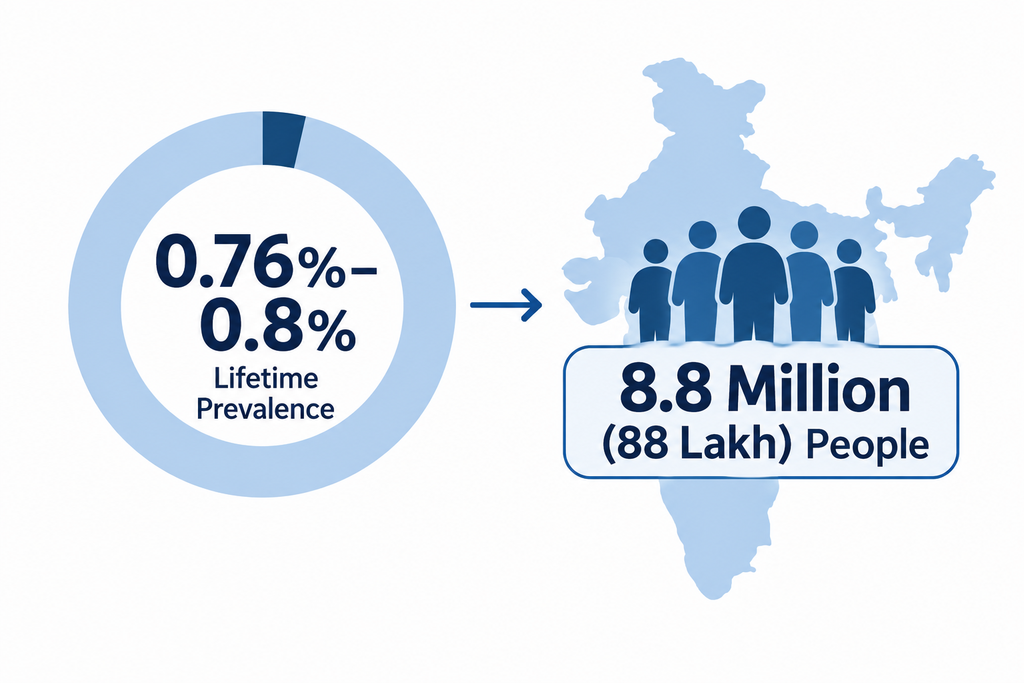
- The National Mental Health Survey (NMHS) of India (2015–2016) updated the lifetime prevalence estimate to 0.76% to 0.8%, translating to roughly 8.8 million (88 lakh) people living with or having experienced OCD
- World Health Organization (WHO) Ranking: The WHO historically ranked OCD among the top 10 most debilitating illnesses globally due to severe anxiety, time consumption, and social impairment. It has also been noted as the fifth most disabling condition for women aged 15 to 44 years.
What Are The DSM-5-TR Criteria For Diagnosing OCD?
Diagnostic criteria for Obsessive-Compulsive Disorder (OCD) DSM-5-TR To be diagnosed with OCD, the following must persist:
Criterion A : Having obsessions, compulsions, or both
- Obsessions: Recurrent, intrusive, and unwanted thoughts, urges, or images that cause anxiety or distress. Individuals may attempt to suppress or neutralize them.
- Compulsions: Repetitive behaviors (such as excessive handwashing or checking) or mental acts (such as counting) performed in response to obsessions or rigid rules, often to reduce distress or prevent a feared event.
Criterion B: Time-consuming or distressing symptoms
- Symptoms take up more than one hour per day or cause significant distress or impairment in daily functioning.
Criterion C: Exclusion of medical or substance-related causes
- Symptoms are not attributable to a substance, medication, or another medical condition.
Criterion D: Exclusion of Other Mental Disorders
Symptoms are not better explained by another mental health condition, such as Generalized Anxiety Disorder or Body Dysmorphic Disorder.
A thorough clinical assessment by a qualified mental health professional is essential for an accurate diagnosis.
What Is The Treatment For OCD?
An individualized treatment approach needs to be taken. Severity of symptoms, individual requirements, medical history, and response to previous medical interventions determine the most suitable treatment for OCD.
Exposure and Response Prevention (ERP)
Exposure and Response Prevention (ERP) is an established first-line psychological treatment for effectively treating Obsessive-Compulsive Disorder (OCD).
This approach includes:
- The gradual exposure to feared situations and thoughts.
- Learning to withstand anxiety without engaging in compulsions.
- Learning healthier coping mechanisms for intrusive thoughts
- Lessening dependence on compulsive behavior to ease anxiety.
Selective Serotonin Reuptake Inhibitors (SSRIs) and the tricyclic antidepressant Clomipramine:
The primary gold-standard medications are used to treat Obsessive Compulsive Disorder (OCD).
Tricyclic antidepressant that strongly blocks serotonin reuptake. It is often prescribed if an SSRI trial does not work, though it carries a higher risk of side effects like dry mouth, sedation, and heart rhythm changes.
The choice of treatment, dosage (if required), and length of treatment must be determined by a qualified psychiatrist. It might take up to a few weeks for any improvement to be noticeable, and one should not stop or change the treatment without the supervision of a qualified psychiatrist.
Combined Treatment
In certain cases, individuals require taking CBT together along with medicines rather than using just one method for the effective treatment of OCD.
Please note that family support and awareness are of immense value. Understanding OCD can help family members respond with empathy and without inadvertently reinforcing compulsive behaviors.
Please remember:
- Not every patient requires medications.
- Combined treatment is not necessary in every case.
- The treatment is individualized.
A qualified mental health professional performs a thorough clinical assessment to recommend the most suitable treatment.
When To Seek Professional Help?
You should consider speaking with a qualified psychiatrist if your intrusive thoughts or behavior:
- Take up a significant amount of time each day.
- Create incessant anxiety, fear, or emotional distress.
- Disrupt work, studies, or social relationships.
- Make it hard to do routine activities.
- Even with the repeated attempts, it seems harder to control.
Getting the diagnosis early can help to identify symptoms, rule out other conditions, and set up an appropriate treatment plan.
OCD Diagnosis and Treatment at AIMAN Hospital
Recognizing OCD is an important step to managing its impact on day-to-day life. Symptoms can vary greatly from one person to another, so treatment should be based on a thorough clinical assessment rather than on assumptions and self-diagnosis.
Professional mental healthcare and individualized treatment approaches remain core to supporting people experiencing mental health concerns at AIMAN Hospital. When people seek help from qualified mental health professionals, they can gain a better understanding of their symptoms and explore appropriate treatment options.
OCD is a treatable mental health condition, and asking for help is not a weakness. With the right therapy, medication when needed, and ongoing professional support, people can aim to manage their symptoms better and function better in their day-to-day lives.