
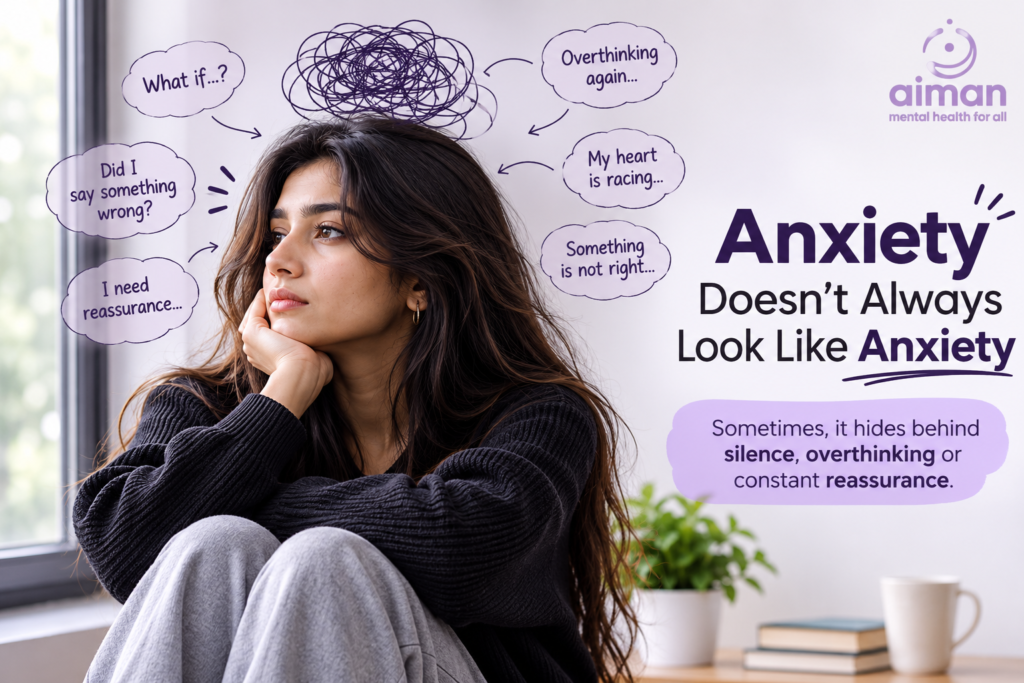
Have you ever found yourself rehearsing a conversation that hasn’t happened yet? Replaying something you said hours ago, wondering whether you should have said it differently? Or lying in bed, exhausted, while your mind seems determined to solve every possible problem before morning?
Working as a psychologist in a psychiatric inpatient setting has changed the way I understand anxiety. I have come to realise that anxiety is not always the visibly distressed person we imagine. It can be much quieter, sometimes even hidden behind behaviours that are easily misunderstood.
Hidden signs of anxiety
It may look like someone asking the same question repeatedly, needing constant reassurance that everything will be okay. It may look like irritability when plans change, an overwhelming need to stay in control, or avoiding a conversation because of everything that could possibly go wrong. Sometimes, it looks like silence.
That is what makes anxiety so difficult to recognise: it does not always look like fear.
Why anxiety is harder to see in inpatient care
In an inpatient setting, people are often navigating several uncertainties at once. They may be away from familiar surroundings, worried about their relationships, concerned about their health or struggling to understand what the future holds, while being disconnected from the outside world because of restrictions on devices. In such circumstances, even seemingly ordinary decisions can feel overwhelming.
The mind begins to search for certainty. It anticipates problems, imagines worst-case scenarios and tries to prepare for outcomes that may never happen. A single unanswered question can become a hundred possibilities.
Physical signs of anxiety
Anxiety is also far more physical than we tend to acknowledge. A racing heart, tightness in the chest, shallow breathing, disturbed sleep, restlessness and stomach discomfort can become part of the experience. For some, these sensations are frightening enough to trigger another wave of worry. A racing heart becomes a reason to panic, and the panic makes the heart race further.
This is why telling someone to “just stop worrying” rarely helps. Anxiety is not simply a failure to think positively. It involves an interplay between our thoughts, emotions, physical sensations and behaviours.
What lies beneath the behaviour
I have also learnt that what we see on the surface does not always tell us what a person is experiencing underneath. What appears to be anger may be fear. What looks like resistance may be an attempt to avoid emotional discomfort. What seems like excessive control may be an effort to feel safe when everything else feels unpredictable.
Understanding this does not mean overlooking difficult behaviours. It means becoming curious about what might be driving them, rather than responding only to what we see.
Perhaps we need to change what we expect from recovery
In psychological work, there is something I find particularly important: regulation before insight.
We often expect people to understand their thoughts, challenge their beliefs and make changes while they are still overwhelmed. But when anxiety is at its peak, even making sense of an experience can feel exhausting.
Sometimes, the first step is much smaller: recognising the early signs of anxiety, slowing down, grounding ourselves in the present, establishing a predictable routine or learning to sit with an uncomfortable feeling without immediately reacting to it.
Gradually, therapeutic work can help people recognise patterns, question unhelpful thinking and approach situations they may have been avoiding. Progress may not look dramatic. It might simply be choosing not to seek reassurance for the tenth time, having a difficult conversation, or allowing an uncertain situation to unfold without trying to control every outcome.
Recovery does not mean never feeling anxious
Working in mental health has also made me reconsider the idea that recovery means never feeling anxious again. Anxiety, after all, is a normal human emotion. It alerts us to potential challenges and helps prepare us to respond. The difficulty begins when it stops being a signal and starts becoming the decision-maker.
Perhaps the goal is not to live a life without anxiety, but to build one in which anxiety does not decide how we live.
To be able to feel nervous and still show up. To experience uncertainty without assuming the worst. To recognise a difficult thought without treating it as a fact.
And perhaps one of the most meaningful things a person can eventually say is not, “I am no longer anxious.” It is, “I was anxious, but I didn’t let it stop me.”
Book a consultation with AIMAN to talk through what you are experiencing with one of our counselling psychologists or psychiatrists. Book online at aimanhealth.com/appointment or call +91 88008 33411.
Frequently asked questions
What are the hidden signs of anxiety? Anxiety can show up as irritability, constant reassurance-seeking, avoiding conversations, a need for control, or withdrawal and silence. It can also appear as physical symptoms such as a racing heart, poor sleep or stomach discomfort.
Can anxiety cause physical symptoms? Yes. Anxiety can cause a racing heart, chest tightness, shallow breathing, restlessness and stomach upset. If you have chest pain or breathlessness that does not settle, seek urgent medical care first.
Is anxiety the same as fear? Not exactly. Fear is a response to a present threat, while anxiety is often about anticipated or uncertain threats. Anxiety can also show up as anger, control or avoidance rather than visible fear.